Bridge by Armada + NVIDIA Run:ai: Commercial or Open Source, Your Call

On October 13, NVIDIA released the complete Run:ai platform as open source. KAI Scheduler, the scheduling engine behind Run:ai, has been open source since 2025. The new release adds the rest of the platform:
- Run:ai control plane and cluster services, so the full integrated platform can be self-hosted, and installed from a single Helm chart
- GPU Fractioning Operator, which brings CUDA-native GPU fractions with hard memory isolation to Kubernetes, plus per-pod metrics
- KAI Resource Management, the organizational layer of projects, departments, quotas, and node pools
- Workload Map, a common contract for managing PyTorchJob, RayCluster, KServe, Dynamo, and custom workload types without hardcoding each one
Production-grade GPU orchestration no longer requires a license.
For neoclouds and sovereign cloud providers building on Armada Bridge, that's good news. Bridge already integrates with commercial NVIDIA Run:ai, and the same integration now extends to the open source release. Tenants who want Run:ai can get it without a procurement step, and every Bridge deployment gets a lower total cost of ownership.
See the Bridge demo with open source Run:ai.
Different layers, one GPU cloud
The easiest way to see how Bridge and Run:ai fit together is to ask what each one decides.
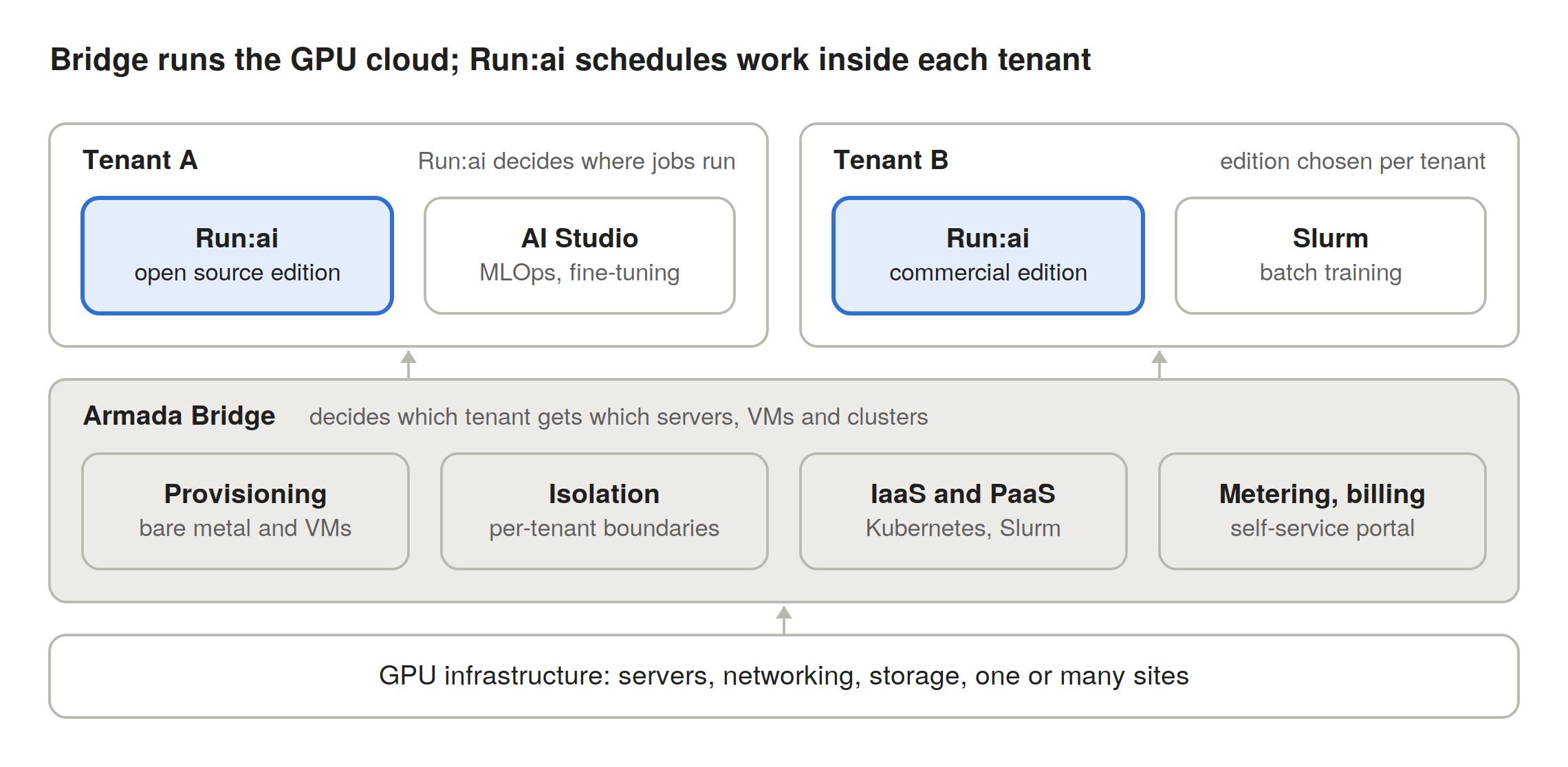
Run:ai decides where a job runs inside a Kubernetes cluster. It handles gang scheduling, fair-share quotas, topology-aware placement, and GPU fractioning, so the teams sharing a cluster get the most out of every GPU.
Bridge decides which tenant gets which servers, VMs, and clusters (in an isolated and secure manner) in the first place. It provisions bare metal, carves capacity into isolated tenants, delivers IaaS (bare metal and VMs) and PaaS (Kubernetes, Slurm, JupyterHub), and meters and bills for everything consumed. One schedules work; the other operates the GPU cloud that work runs on.
So, the two stack naturally. Bridge supplies everything beneath and around Run:ai: hardware lifecycle, external-customer isolation, a self-service tenant portal, billing, IaaS, and PaaS. Inside their own isolated environment, tenants choose their tools, and Run:ai is one of them.
How it works on Bridge
On Bridge, Run:ai is a Platform. A tenant deploys it from the Bridge Marketplace and works through Run:ai's own tools to schedule batch jobs and serve inference within its allocation. Because each tenant already gets its own environment from Bridge, its Run:ai instance sits inside that tenant's boundary. Per-tenant compliance with zero spillover.
Run:ai focuses on scheduling, so Bridge keeps the rest of the AI lifecycle in reach. Bridge AI Studio covers MLOps pipelines, model optimization, Jupyter workspaces, fine-tuning, benchmarking, and security scanning, and the Bridge Marketplace adds ISV partner models, platforms, and apps. A single tenant can run Slurm for training, Run:ai for batch and inference, and AI Studio for pipelines, all on the same governed capacity.
Choose your edition
Open source Run:ai suits operators who want to move fast and own their support: pilots, dev/test tenants, cost-sensitive offerings, and teams that want to contribute upstream.
Commercial Run:ai suits production environments that need NVIDIA enterprise support, available standalone or through NVIDIA AI Enterprise and NVIDIA Mission Control.
Both run on the same Bridge foundation, so the choice can be made by each tenant and revisited as workloads grow.
Why it matters
Open source lowers the barrier to orchestrating GPUs. Turning those GPUs into a business still takes provisioning, isolation, sovereignty, and billing. Pair Bridge with Run:ai, in either edition (commercial or open source), and operators get a complete path from racked GPUs to revenue-generating AI services.
Some of these components are useful well beyond Run:ai itself. Workload Map and KAI Resource Management operate at the Kubernetes layer and don't depend on CUDA. Bridge plans to integrate them as generic platform capabilities, giving every tenant a consistent way to manage workloads, quotas, and teams, whether or not it runs Run:ai.
Get started
Whether you're standing up your first GPU cloud or scaling a sovereign AI platform, Bridge gives you Run:ai your way. Contact the Armada team to see it in action.